
Sunday, June 24, 2018
Gladish gymnasium

Fortunate to have Oscar Gladish as her Pullman High School teacher, principal
Her
View: A lesson in intelligent protesting
By Lenna
Harding, Moscow Pullman Daily News April 5, 2018
I have enormous respect for the teenagers in Parkland, Fla.,
as they demonstrate to the country the proper way to lobby and protest.
They are a far cry from the destructive and disorderly
protests by young people during the Vietnam War. I suspect many older adults
who disparage their efforts are those same earlier protesters. I have long felt
the reason the earlier protesters acted as they did was because of a failure of
our school system to teach them how to work within the system to achieve their
goals. They belong to the same generation as my daughter, who never had a
civics course from elementary to graduate school.
It was a required course in Washington high schools when I
was attending, and I was even more fortunate to have Oscar Gladish as my
teacher. He not only taught civics and an American history course - also
required - but as principal, he had set up an elaborate student government
program at Pullman High School.
Making policy was a student council composed of elected
officers and a representative from each class. Then there was also student
control in charge of discipline. If a member spotted an infraction of school
rules, the miscreant would be cited and had to appear before the council for
trial.
Punishment was so many minutes helping either the janitor or
home economics teacher after school. The infractions might have been sitting on
desk surfaces, defacing desks (punishment was resurfacing the top under
instruction of the shop teacher), being in the halls during class time without
a pass (there were hall monitors at key locations in the halls) and running in
the halls.
Another "agency" was the fire patrol in charge of checking
fire extinguishers, arranging fire drills with the city fire department and
monitoring them for the time it took to evacuate the building.
This gave us practical lessons about the function and
structure of government at various levels. It also demonstrated that government
is the people, both by their vote as well as actual participation by running
for office and lobbying. I've often wondered how the war protesters would have
acted if they had a better understanding of the workings and system of government.
These Parkland students are doing almost everything right
and setting a marvelous example to their peers elsewhere as demonstrated by the
many peaceful, meaningful demonstrations throughout the country in support of
Parkland and other schools that experienced violence.
Registering new voters strengthened their clout as they vow
to elect new legislators who will listen and act to correct what they perceive
are the causes of the violence. They directly lobbied leaders and simply
protested. The marches were well planned and orderly, and the speeches
eloquent. The fact that other teenagers throughout the country are taking their
cues from this is heartening.
The big question now is: how long can this momentum continue
if they don't get what they want? Will they lose heart or simply run out of
steam? It's so nice to see the number of adults in the marches with them, but
I'm not sure that is enough. I think it falls on the rest of us grown-ups to
take up the sword as well and help maintain the momentum.
Instead of ridiculing or demonizing them as some adults are
doing, we should be bombarding those in Congress and state legislatures with
organized group lobbying, letters to the editors, phone calls and all the other
correct ways to lobby. I believe these teenagers deserve our validation of
their efforts.
Our children only want safety in schools, the right to life
and the right to not live in fear. The measures they ask are reasonable and
well within the Second Amendment provisions. I personally think we could enact
even further restrictions and still be well within the Constitution.
Lenna
Harding lived her first 20 and past 43 years in Pullman. A longtime League of
Women Voters member, she served on the Gladish Community and Cultural Center
board. lj1105harding@gmail.com, ljharding.com
Wednesday, June 13, 2018
PULLMAN IN ‘TOP 30’ OF MOST BEAUTIFUL TOWNS IN AMERICA, SAYS EXPEDIA IN JUNE 2018

City of Pullman photo from http://www.pullman-wa.gov/about-pullman/greening-of-pullman/downtown-pullman-riverwalk-project
On June 7, 2018, Expedia posted this by Chloe Mulliner
Most beautiful towns in America: Part 2
Searching for beauty high and low
Of course, beauty is subjective, but there are some things on which we can all agree. A charming downtown oozing with character, sparkling waves under the glow of a sunset, and wide-open ranges void of human handprints are all undeniably beautiful in their own ways.
Not too long ago, we curated a list of our favorite beautiful towns in America, and we’re back at it again. From endearing architecture and preserved nature trails to serene coastlines and mountaintop views, we’re bringing you even more pretty towns and cities from sea to shining sea.
.............
(Here's what the June 7, 2018, Expedia posting said about Pullman.)
30. Pullman,
Washington
The small town
of Pullman is especially good looking when the trees turn amber along Main
Street and the Pullman Riverwalk, but some might consider the surrounding
Palouse region the real draw; a magical display of rolling hills and wind-blown
silt.
(For more info, PULLMAN :: Cup of the Palouse, provides the following amplifications.)

............
Oh, you noticed
"wind-blown silt" in Expedia text? If you are curious about that
silt, go to "The Seven Wonders of Washington State" at URL below ...
... text there
says, "The Palouse is the most serene and pastoral of the seven wonders of
Washington State. It is a region in south eastern Washington characterized by
gentle rolling hills covered with wheat fields. The hills were formed over tens
of thousands of years from wind blown dust and silt, called "loess",
from dry regions to
the south west. Seen from the summit of 3,612 foot high Steptoe Butte, they
look like giant sand dunes because they were formed in much the same way. In
the spring they are lush shades of green when the wheat and barley are young,
and in the summer they are dry shades of brown when the crops are ready for
harvest. The Palouse hills are not only a landscape unique in the world, but
they are beautiful to behold, making them my favorite of the seven wonders of
Washington State."
...................
Expedia
mentions Pullman Riverwalk. About it, TrailLink says, “Pullman's Downtown
Riverwalk trail is part of system of trails that make a loop around the city.
The Riverwalk runs for a short distance through downtown, linking with the
College Hill Climb Trail on the north end and the Koppel Farm Trail on the
south end. Sign posts guide you along the trail system.”
More info here:
Tuesday, May 29, 2018
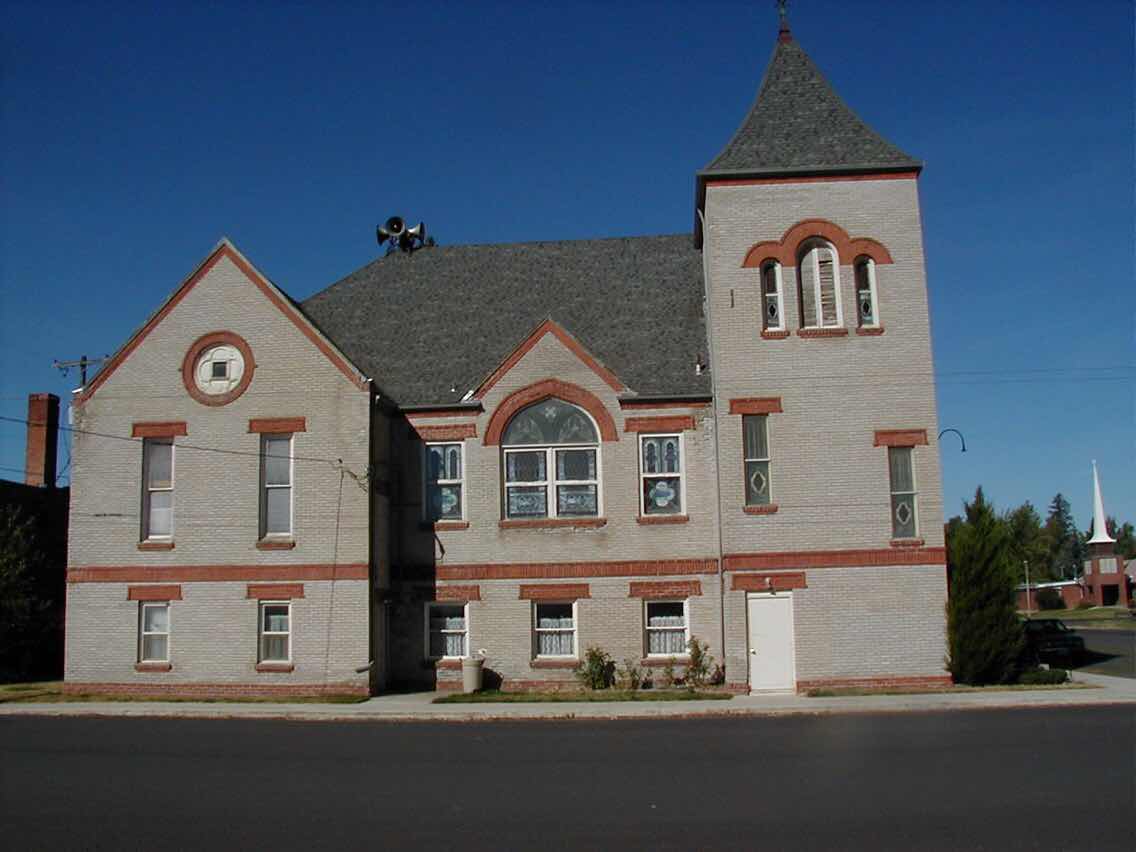
Garfield United Methodist Church closed Sunday May 28, 2018: Opened in 1881
Garfield (Whitman County), Washington


Story from 5/23/2017 Whitman County (Colfax) Gazette. Photos from 1999 of Garfield UMC provided by Jim Storms. Art work of Garfield UMC provided by Mary Ann Storms.
Garfield Methodist Church to close Sunday after 137 years: The last service
By Garth Meyer, Gazette Reporter, May 23, 2018
On Sunday, the Garfield Methodist Church will hold a service for the last time.
Founded in 1881 with a circuit preacher visiting private homes, the Garfield church got its first pastor six years later. The congregation bought land and the current church on Second Street was built in 1906.
Peggy Ray, its 63rd pastor, will lead the final service at 10:30 a.m. May 27.
Afterwards, the church will close with religious items removed and a de-consecration performed. The Town of Garfield has agreed to buy the building for $1 to use it as an auditorium for public events.
“I think it’s sad that it’s closing but I’m pleased that the building will be used, and still be an asset to the community,” said Ray.
 With the closing of the church, she will retire after nine years as pastor.
“I’m 79, it’s time to retire,” Ray said. “I was hopeful they would be able to continue after me. But that didn’t seem so reasonable after the last year. Basically the church is not in a position to replace me.”
The tall, brick Garfield building has a regular capacity of 100 people. Its closing is permitted by the larger United Methodist organization.
“It’s the culmination of a long process,” said Rev. Greg Sealey, supervisor for the United Methodist Church Inland District encompassing the Eastern half of Eastern Washington and part of the Idaho panhandle.
“A church generally decides for themselves, that they don’t have the money or energy to continue. Organizations, like organisms, often have a life cycle.”
 The Garfield location is the only church in Sealey’s zone now closing, after two did last year, in White Bird, Idaho, and Wild Rose, an unincorporated area by Deer Park.
“A church closing doesn’t mean a church has failed. They did good work and they lived out their purpose,” Sealey said.
From 2007 to 2009, a drop in congregants in Garfield occurred after the Methodist church’s last full-time pastor left.
“We had about 30 people on Sundays when the Osveds were here,” said Mary Ann Storms, a member since 1970, referring to Pastor Joel Osved and his family. “Then it dwindled to 15 and 10 and five.”
Rev. Ray has served as a quarter-time pastor.
“I didn’t think seriously about closing until about a year ago,” she said.
In January, the church went to an every-other-Sunday format, due to its low numbers and to allow a chance for congregants to visit other churches. The Seedlings Child Care Center, started by the church and Garfield School in 2012, will continue on the church’s lower floor.
Sealey will be on site Sunday to perform the de-consecration rite. As a consecration opened the church 7,100 Sundays ago, this will mark its conclusion.
“We have a service to celebrate all the work the church has done,” Sealey said. He and local church members will also remove hymnals, religious symbols and other imagery, including the cross and flame logos of the Methodist Church, to prepare for the handover to the town.
“The conference doesn’t want the church back, they’ve got other empty churches,” said Storms.
Ray plans for the final service to include a wide selection of favorite hymns from remaining congregation and time for shared memories.
“Just like a lot of churches, the population dwindles and young people are not going to church like they used to,” said Storms, who will now drive to Colfax on Sundays. “This winter it got down to too few of us to make it viable. We’ve got younger people that don’t go to church. My kids don’t go to church.”
Garfield Methodist was known for its large choir in the early- and mid-1900s, with instrumental accompaniments. They lost their last organist/choir director at the end of 2014 when Janet Foley moved to California.
“It’s acoustically perfect,” said Ray of the building. “It’s a good size for the community.”
Garfield will now have two churches remaining in town; Garfield Christian Fellowship and Garfield Community Church.
“It’s never one thing that closes a church,” Sealey said. “There has been a shift in our larger culture. It used to be everyone went to church. Younger people, in the smaller towns, there’s not a lot of jobs for them. That’s a challenging place to have a church.”

Tuesday, May 15, 2018
::: Pat-Topics: Story about Pullman's Pat Caraher, WSU grad, longtime HillTopics editor :::


Dave
Nordquist’s wonderfully-written story about Pat appears in the Spring 2018 WSU
Retirees Association Newsletter. Thanks Pat and Dave for jobs well done!
Read
the story below:
:::Pat-Topics:
Story about Pat Caraher:::
By Dave Nordquist
Spring 2019 WSU Retirees
Association Newsletter
I
asked some of Pat Caraher’s friends and family to describe him in two words or
less.
The
responses were interesting, yet not surprising to someone who knows Pat.
His
coffee klatch buddies said: “Kind Hearted,” “Mr. Sincere,” “Unassuming,” “True
Gentleman.”
Given
the regard in which he is held by others, as evidenced by the two word
descriptors, his work ethic and personality, it isn’t surprising that he was
able to get his dream job at WSU. In a bit of a twist on the old cliché, “It
isn’t what you know, but who you know”, it’s fair to say that Pat got his dream
job at WSU both because of “what he knew” and “who he knew.”
What
he knew was journalism. Degree from WSU in Communications with journalism
emphasis, chosen outstanding graduate in journalism upon his graduation, three
semesters working on the Daily Evergreen
staff while at WSU, stringer for the Seattle
Post-Intelligencer newspaper while still a student and intern in the Sports
Information Office while at WSU. And then, after graduation, three and one half
years working for the Eugene, Oregon Register-Guard.
Oh, “Humble Pat” (my 2 word descriptor) would be the first to say he had much
more to learn about his profession but he was well on his way.
So
he’s 3 ½ years in Eugene and he said that he began pondering what’s more
important in life: Location or Job. He likes where he lives – easy access to
the ocean, about the right distance from Portland, all the amenities of a large
university near at hand and he likes the job pretty well but there are some
drawbacks. Working schedule for one. Working in the office during the day and
then having to cover nighttime sporting events. He wonders how all that might
shake out if and when he gets married and has a family. As he ponders this, he
gets a phone call from another Pat, the “Who you know” part of the equation.
But
before you learn about this other Pat who called, you need to know more about
the Pat who got the call, Pat Caraher. He was born and grew up in Seattle. His
Dad, Joe Caraher, was a Cougar, having graduated from then WSC in 1935 and then served
as the WSC Alumni Director prior to WWII.
After the war Joe was twice President
of the WSU Alumni Association so Pat had Cougar influence in his life from the
git-go. Pat had a normal growing-up time in Seattle. One thing he really
enjoyed from a young age was baseball. He played in some of the very first
Little League games in the Seattle area and later first base and outfield for
his high school team. He graduated from Seattle Prep in 1957 and then had to
decide where to attend college. Two things swayed him towards Pullman and WSU.
One, he wanted to go somewhere away from Seattle and two, his father influenced
him to a great extent.
So
he enrolled at WSU in the fall of 1957 not knowing anyone there and not knowing
what he wanted to study. He solved the “not knowing anyone bit” by going
through rush and joining the Phi Kappa Theta Fraternity. As to the “what to
study” he took general courses and got a degree in Social Science in 1962. He
noted that famous WSU Alum Edward R. Murrow was the commencement speaker that
year.
Upon his graduation, Uncle Sam was waiting for him and he was drafted
into the army and spent his next two years at Fort Richardson in Alaska. Pat
relates that two notable events occurred while he was at Fort Richardson. First
was the assassination of President Kennedy in 1963 and the second was the massive
9.2 Good Friday Alaska earthquake in 1964. The buildings shook and the ground
trembled for several minutes, “seemingly an eternity,” Pat said. “In a flash my
life passed before my eyes.”
After
discharge from the army he went back to Seattle and looked for work. He said
the job market was tough. He worked a couple of months in construction and then
three months as a railroad switchman. These five months of manual labor plus
some thinking about his future, convinced him he needed to go back to school and
get more of a specialty degree and he settled on journalism. His father was a
journalist and Pat saw that his father liked what he was doing so Pat
re-enrolled at WSU in January 1965 majoring in Communications. He graduated in
1966 and armed with that degree and the work experiences noted earlier, got the
job with the Eugene
Register-Guard.
We’re
now back to 3 ½ years in Eugene and his pondering about “Job vs Location” when
he gets that call from the other Pat. That “other Pat” is Pat Patterson, WSU’s Alumni
Director. The Alumni Office had been one of Pat Caraher’s beats while working
on the Evergreen Staff as a student, so he knew Pat Patterson and more
importantly, Pat Patterson remembered him and thus the call.
Pat
Patterson said the Alumni Office was going to start a new alumni publication and wondered if Pat was interested in interviewing
for the editor’s job. The words “Job vs Location” flashed through his mind and
he quickly said, “Yes.” He interviewed, got the job and became the Founding,
and as it turned out, the only Editor of the new publication, which was given
the name HillTopics, for its 31 year
run at WSU.
He
moved to Pullman in 1969 and began his 35 year career at WSU, for 31 years as Hilltopics editor and four more as
Co-Editor of the Washington State
University magazine, which was the successor magazine to Hilltopics. Pat said his 31 years as Hilltopics editor were very interesting
and satisfying because he got to know people from all aspects of WSU life. His
list of friends, acquaintances, and interviewees reads like a Who’s-Who of all
the movers and shakers at WSU during those years. The job was also a bit
taxing. Ten issues a year (later cut back to 8) with 24 pages each issue.
That’s a lot if interviewing.
Pat’s
working companions in University Relations had nothing but good to say about
him. A few quotes: “I never saw him angry,” “Wow, could that man write,” “He
was totally dedicated,” “All Around,” “Always Inquisitive,” “Trusted Friend.”
It
was during those early years back at WSU that he met Laurie (Busch) Caraher, his wife also a
Cougar (’75 Music Education). They met in church. Laurie was from a Pullman
family which was also a golfing family. Pat said their first date was playing
golf on the old WSU nine hole golf course. They got married in 1976. Pat and Laurie have three daughters, Maureen,
Kelly and Theresa all of whom graduated from WSU and who have produced four
grandchildren for Grandpa Pat to spoil.
Family members, including a couple of
grandkids, described Pat as follows: “People Person,” “Selfless,” “Loyal,” “Consistent,” “Faithful,” “Lifetime Volunteer,”
“Pullman’s Mayor,” “Lots of Friends,” “Likes to Read.” One elaborated on her
choices by saying, “Selfless because he always puts others before himself and
Loyal because he is loyal to his family, friends, community, faith/church and
his beloved Cougs.”
Because
of his work on HillTopics and other
WSU and community activities, Pat received the WSU Alumni Achievement Award in
1995.
Pat’s
hobbies and activities apart from work were and are quite varied: International
and domestic travel, reading books, newspapers and obituaries. Obituaries
because each one is a vignette of a person’s life, birth to death. He also
likes golfing and exercising, particularly walking with Laurie and friends, and
all Cougar sports, especially baseball which he calls his “love and vice.”
He
was a Rotary Club member for 42 years. Rotary’s motto of “Service above Self”
certainly epitomizes who Pat is. Also, for the last 14 years Pat has served as
a Volunteer Chaplain at Pullman Regional Hospital. And he can’t stop writing.
In 2016 he started writing random stories of his memories and reflections. The
titles of two so far are: “Three Broken Teeth and Two Broken Legs,” and “Flying
Kites and Building Sand Castles.” I told Pat he should combine these stories in
book form and title it “Pat-Topics.”
So,
back in Pullman at WSU, Pat got both “Location” and “Job satisfaction”, a wife
and family and many friends. Pat said he loved his job and his wife, “Best
thing that ever happened to me,” he said, meaning his wife not the job. But
maybe the job was second best.
The story is posted at these blogs:
-News
for CougGroup
http://newsforcouggroup.blogspot.com/2018/05/manyknow-pullmans-pat-caraher-but-dont.html
http://newsforcouggroup.blogspot.com/2018/05/manyknow-pullmans-pat-caraher-but-dont.html
-Pullman
:: Cup of the Palouse
https://pullman-cupofpalouse.blogspot.com/2018/05/pat-topics-story-about-pullmans-pat.html
https://pullman-cupofpalouse.blogspot.com/2018/05/pat-topics-story-about-pullmans-pat.html
Also, see WSU news release 9/7/2004, 'Long-time Cougar Writer, Editor Patrick Caraher to Retire'
Thursday, April 19, 2018
Pullman's historic Northern Pacific Depot purchased by Whitman County Historical Society


--A “Cougar Special” train arrives from the Seattle/Tacoma area at the Northern Pacific Railroad depot in 1920 in Pullman. Thousands of WSU students traveled across the state on these trains after the depot’s brick building opened March 9, 1917.
--This 1915 photo shows the wooden depot that was constructed in 1901, located east of Grand Avenue along Missouri Flat Creek, after the Northern Pacific Railroad depot was moved closer to the tracks to help commuters avoid walking in the mud.
--This photo shows the Northern Pacific Railroad depot's brick building, which opened March 9, 1917, in Pullman.
--This photo shows the Pufferbelly Depot in its current state at the corner of North Grand Avenue and Northeast Whitman Street in Pullman.
From
Whitman County Historical Society NEWSLETTER Vol. 45, No. 2 – 2018 (Apparently mailed April 2018).
PULLMAN
DEPOT PURCHASED
Additional
good news was announced in mid-February when the Whitman County Historical
Society acquired the historic Northern Pacific Railroad Depot in Pullman. This
iconic downtown building is a symbol of Pullman’s rich heritage. The Society
decided that its purchase would enable the preservation of the building as a
historical site, leading to an eventual railroad and Pullman history museum
The depot
was recently owned by the late Dan Antoni. His daughter, Meghan, who inherited
the property, was seeking a way to preserve it. Contact was made with the
Society about the possible purchase and discussions followed. The acquisition
was made possible with an anonymous local backer stepped forward and negotiated
with Ms. Antoni to secure the property for the Historical Society.
The Board
appointed Kathy Meyer and Linda Hackbarth as co-chairs of a steering committee
to 1) raise funds to repay the loan and finance future development of the
museum, 2) plan for the future use of the facility and its administration, and
3) move forward on needed renovations and improvement.
Anyone
interested in serving on this steering committee is urged to contact Linda (lindahackbarth39@gmail.com) or
Kathy (klmeyer@gmail.com). Much help
will be needed to make this museum a reality.
::::
Dan Antoni
died of a heart attack at age 63 on Dec. 30, 2015. His obituary appeared in the Sept. 3, 2016, Moscow Pullman Daily News. The obit included that he was born in
Portland and graduated from David Douglas High School in Portland and the University
of Oregon in Eugene. "In the late '70s/early '80s, Dan moved to Pullman
and fell in love with its small-town charm. Dan worked as a substitute math and
science teacher at Lincoln Middle school, owned and operated two restaurants:
Barley & Hopps bar on campus and Chovies submarine shop downtown before
finding his true calling in real estate."
::::::::::
Nearby
History: WCHS purchases historic Northern Pacific Railroad depot
By Linda
Hackbarth
Moscow
Pullman Daily News, April 14, 2018
(Linda
Hackbarth is the webmaster and newsletter editor for the Whitman County
Historical Society.)
The
Whitman County Historical Society jumped on the unique opportunity to purchase
the Northern Pacific Railroad Depot in Pullman when it became known a sale was
imminent.
The
building was renamed the Pufferbelly Depot after the late Dan Antoni bought it
in 1988. Antoni turned a portion into his real estate office and rented the
eastern side to the vehicle licensing department. He added three Pullman cars,
a locomotive and a Great Northern caboose, all of which he placed on rails next
to the building. His daughter, Meghan Antoni, inherited the property and was
seeking a way to preserve it. Contact was made with WCHS about the possible
purchase, and discussions followed. The acquisition became feasible when an
anonymous local donor stepped forward and negotiated with Meghan Antoni to
secure the entire holdings for the historical society.
WCHS,
organized in 1972, purchased and restored the Perkins House and cabin in Colfax
as one of its first efforts. Its acquisition of the depot adds to its inventory
of historic sites in the county, including two buildings in Palouse - the Roy
Chatters Newspaper and Print Museum and the Trinity Chapel. The historical
society also operates the WCHS Archive in the Gladish Community Center in
Pullman, has partnered with the Lost Apple Project, offers full-day field trips
for schoolchildren at the Jones Schoolhouse on the Palouse Empire Fairgrounds
and publishes a quarterly newsletter and a journal of local history called The
Bunchgrass Historian. The Board of Directors believes the iconic downtown depot
has the potential to evolve into a wonderful railroad and Pullman history
museum.
The
history of the building dates back to the late 1800s and ties directly to the
story of how Pullman got its name. The Spokane & Palouse Railroad, which
became the Northern Pacific, came to Pullman in 1887, two years after the
arrival of Oregon Railway and Navigation Company tracks. OR&N later morphed
into Burlington Northern and finally Union Pacific. Both railroads built depots
to serve the community - the Union Pacific on the south side of the Palouse
River and the Northern Pacific on the north - just a block apart. In 1901, the
NP Depot was relocated a bit closer to the tracks when commuters became tired
of walking through the mud to meet the trains. A spot east of Grand Avenue and
along Missouri Flat Creek became its permanent site. A 32-by-160-foot frame
building was constructed, complete with waiting rooms for both ladies and
gentlemen, a baggage room and a large freight room. A nearby house was acquired
for the railroad agent.
This
building was razed and replaced by the more than 7,000-square-foot brick
structure that exists today. The formal opening on March 9, 1917, attracted a
large crowd, including dignitaries from the railroad company. Over the years,
thousands of WSU students traveled back and forth from Seattle and Tacoma via
"Cougar Special" trains. "Why not get together with your friends
who are going back to college and make up your own little group to travel
together on the Cougar Special?" asked a 1935 NP brochure. The depot
continued to be used until 1970, when passenger service was discontinued. It
then served as offices for the Soil Conservation District until purchased by
Antoni.
The
Historical Society appointed board members Kathy Meyer and myself to co-chair
an exploratory steering committee to raise funds to repay the loan and finance
development of the museum, plan for the present and future use of the facility
and its administration, and move forward on needed renovations and
improvements. These women are in the process of gathering the committee.
"We
invite all railroad buffs, historic preservation enthusiasts, potential museum
planners and general Pullman lovers to join us," they added. "Come to
our first meeting Thursday, April 19, 2018, 6:30 p.m. in the Hecht Room at
Neill Public Library."
For
further information on how to support this effort or become a member of the
steering committee, you are encouraged to contact the following: Kathy Meyer at
(509) 334-9089 or klemeyer@gmail.com; me, Linda Hackbarth, at (208) 627-3460 or
lindahackbarth39@gmail.com; and Jon Anderson, WCHS treasurer, at (509) 595-1427
or jpacpa@pullman.com.
::::::::::::::::::
PULLMAN’S
TWO RAILROAD DEPOT, ACROSS GRAND AVENUE FROM EACH OTHER
--Address
for Pullman’s Northern Pacific Depot is 330 N Grand Ave. In addition to Grand,
it is on or near Northeast Whitman and Kamiaken Streets.
--Address
for Pullman’s Union Pacific Depot (now Umpqua Bank) is 225 N Grand Ave. In
addition to Grand, it is on or near Northwest Davis Way and Northwest State
Street.
::::::::::::::::::
Pullman trains see growing pains
Whitman County Historical Society takes aim at a new restoration project in downtown Pullman: The historic ‘Pufferbelly’ Depot
By Scott Jackson
Moscow Pullman Daily News
Apr 19, 2018
The old Pufferbelly Depot — constructed in 1917 and operational until 1970 — has been sagging into a state of disrepair on the edge of Pullman’s downtown for years, but it could soon be the site of a massive restoration effort if the Whitman County Historical Society can raise the necessary money.
A steering committee will meet today to decide what must be done to convert the entire property into a museum.
WCHS purchased the former Northern Pacific Depot in early March with the help of a $300,000 loan from an anonymous donor, those close to the project say.
“If we want to get historic status for it, we’re going to have to renovate it back to more of its original condition,” Linda Hackbarth, co-chair of the steering committee, said. “Eventually, we’ll have to strip everything down to see what original stuff is here before we can start any restoration process.”
Hackbarth said while there may be grants available for projects concerning historic buildings, WCHS will try to raise most of the necessary money through donations in a public fund drive. She said she hopes to secure at least $1 million for renovations, but some on the steering committee speculate it may take as much as $2 million to $3 million to fully restore the property.
“The question is, how much do you have to raise before you get something going so people see?” Hackbarth said.
She said a rigorous fundraising effort is required to renovate the space.
“You don’t want to be trying to nickel and dime to raise money over five years,” Hackbarth said.
The early work of clearing out relatively recent alterations to the space will be a major first step, Hackbarth said, and it will include tearing down drywall and removing a false ceiling. Hackbarth said the west wing of the structure would likely host the majority of museum operations, leaving room for creative ideas on how to use the remaining space. Annette Pettenger, also on the steering committee, said ideally, the museum would feature both the history of rail and the local history of the city of Pullman.
A lingering question, Hackbarth said, is what to do with the three water-warped railcars abutting the building that were previously converted into living and office spaces. She said the false tracks on which the cars now rest were built by late owner Dan Antoni, on what was once a herringbone brick platform for passengers. She said Antoni, who purchased the depot in 1988, bought the cars in the early 2000s from an outfit based in Portland, had them towed to the site by rail and used a crane to place them on his false tracks. The last car was installed in 2002, she said, and the engine car near the front was brought in during 2008. Antoni died in December 2015.
“The unfortunate thing is, when Dan brought the trains in, he set them right next (to the depot) — so it takes all the light out of the building,” Hackbarth said. “From the viewpoint of town, they cover the whole building, so you can’t see the building from the front side.”
Restoring the railcars themselves will be an ambitious undertaking. Hackbarth said previous renovations were done on the cheap and, as a result of poorly installed windows, mold began to take hold. Hackbarth said she was told not to take a deep breath while inside. She said this might be an exaggeration, but large black swaths of mold can be spied creeping along wall surfaces in the two foremost cars.
“At this point, we’re thinking possibly cannibalizing three and making one decent one,” Hackbarth said.
She said the current tenants, which includes Assurance Driving School and Puffin Glass Studios, will be allowed to stay for the foreseeable future, but may have to leave when restoration begins.
Hackbarth said she hopes to draw interest from the community once residents recognize the historic station’s potential. If done right, she said, a modern, well-planned museum could be just what the city needs.
“It’s a wonderful location for downtown, and I think it could be a real draw to downtown,” Hackbarth said. “This will be such a massive project that this will stand, eventually, independently with its own board of directors and staff for whatever is needed down the line.”
The steering committee’s first meeting is at 6:30 p.m. today in the Hecht Room of the Neill Public Library. It is open to the public.
::::::::::::::::::
Pullman trains see growing pains
Whitman County Historical Society takes aim at a new restoration project in downtown Pullman: The historic ‘Pufferbelly’ Depot
By Scott Jackson
Moscow Pullman Daily News
Apr 19, 2018
The old Pufferbelly Depot — constructed in 1917 and operational until 1970 — has been sagging into a state of disrepair on the edge of Pullman’s downtown for years, but it could soon be the site of a massive restoration effort if the Whitman County Historical Society can raise the necessary money.
A steering committee will meet today to decide what must be done to convert the entire property into a museum.
WCHS purchased the former Northern Pacific Depot in early March with the help of a $300,000 loan from an anonymous donor, those close to the project say.
“If we want to get historic status for it, we’re going to have to renovate it back to more of its original condition,” Linda Hackbarth, co-chair of the steering committee, said. “Eventually, we’ll have to strip everything down to see what original stuff is here before we can start any restoration process.”
Hackbarth said while there may be grants available for projects concerning historic buildings, WCHS will try to raise most of the necessary money through donations in a public fund drive. She said she hopes to secure at least $1 million for renovations, but some on the steering committee speculate it may take as much as $2 million to $3 million to fully restore the property.
“The question is, how much do you have to raise before you get something going so people see?” Hackbarth said.
She said a rigorous fundraising effort is required to renovate the space.
“You don’t want to be trying to nickel and dime to raise money over five years,” Hackbarth said.
The early work of clearing out relatively recent alterations to the space will be a major first step, Hackbarth said, and it will include tearing down drywall and removing a false ceiling. Hackbarth said the west wing of the structure would likely host the majority of museum operations, leaving room for creative ideas on how to use the remaining space. Annette Pettenger, also on the steering committee, said ideally, the museum would feature both the history of rail and the local history of the city of Pullman.
A lingering question, Hackbarth said, is what to do with the three water-warped railcars abutting the building that were previously converted into living and office spaces. She said the false tracks on which the cars now rest were built by late owner Dan Antoni, on what was once a herringbone brick platform for passengers. She said Antoni, who purchased the depot in 1988, bought the cars in the early 2000s from an outfit based in Portland, had them towed to the site by rail and used a crane to place them on his false tracks. The last car was installed in 2002, she said, and the engine car near the front was brought in during 2008. Antoni died in December 2015.
“The unfortunate thing is, when Dan brought the trains in, he set them right next (to the depot) — so it takes all the light out of the building,” Hackbarth said. “From the viewpoint of town, they cover the whole building, so you can’t see the building from the front side.”
Restoring the railcars themselves will be an ambitious undertaking. Hackbarth said previous renovations were done on the cheap and, as a result of poorly installed windows, mold began to take hold. Hackbarth said she was told not to take a deep breath while inside. She said this might be an exaggeration, but large black swaths of mold can be spied creeping along wall surfaces in the two foremost cars.
“At this point, we’re thinking possibly cannibalizing three and making one decent one,” Hackbarth said.
She said the current tenants, which includes Assurance Driving School and Puffin Glass Studios, will be allowed to stay for the foreseeable future, but may have to leave when restoration begins.
Hackbarth said she hopes to draw interest from the community once residents recognize the historic station’s potential. If done right, she said, a modern, well-planned museum could be just what the city needs.
“It’s a wonderful location for downtown, and I think it could be a real draw to downtown,” Hackbarth said. “This will be such a massive project that this will stand, eventually, independently with its own board of directors and staff for whatever is needed down the line.”
The steering committee’s first meeting is at 6:30 p.m. today in the Hecht Room of the Neill Public Library. It is open to the public.
Subscribe to:
Posts (Atom)