Sunday, July 29, 2018

WSJ covers the Palouse; reporter enamored with Moscow, hardly gives Pullman time of day 7/27/2018


A Grain Escape to the Palouse
The swoon-worthy landscapes and small-town charms of this Northwest region
WSJ/Wall Street Journal, July 27, 2018 2:32 p.m. ET,
TRAVEL


A Getaway to the ‘Tuscany of America’
The Palouse—a scenic farm region on the Washington-Idaho border—is often compared to Tuscany, but with pie shops and ice-cream socials
The view on the drive up Steptoe Butte along the Palouse Scenic Byway.
Sunrise from Steptoe Butte, Wash.
The Latah Trail, a 13-mile path between Moscow and Troy, one of the area’s many rails-to-trails paths.
Along the Latah Trail. The Palouse encompasses some 4,000-square miles of farm country.
Strawberry rhubarb pie from the Pie Safe Bakery & Kitchen in Deary, Idaho.
Artisan cheese at Brush Creek Creamery, which shares a space with the Pie Safe Bakery & Kitchen.
Tanner Collier at Lodgepole restaurant in Moscow, Idaho.
Lodgepole serves sophisticated takes on regional staples such as guajillo chili-dusted fried garbanzo beans.
Rebecca Ashbach at the Lodgepole restaurant.
The Hunga Dunga Brewing Co. in Moscow, Idaho.
Hunga Dunga Brewing Co. in Moscow, Idaho.
Sunrise from Steptoe Butte, Wash. BROOKE FITTS FOR THE WALL STREET JOURNAL
By Matthew Kornberg, Wall Street Journal,
July 27, 2018 2:33 p.m. ET
MY WIFE AND SON laughed at me when, for the third time in less than a mile, I stopped our rental car, stepped onto the gravel road and took yet another wholly inadequate cellphone picture of the rolling fields that surrounded us.
Soon they clambered out too and fell quiet. We were in the Palouse, a roughly 4,000-square-mile agricultural region that straddles the Idaho-Washington border. Intensely fertile, the region is defined by its dune like hills, formed eons ago by windblown silt.
The hills, gold and green with grains and legumes, undulate without pattern or rhythm; every bend in the road reconfigures the landscape in unpredictable ways, leaving you feeling just a bit off kilter, in a perpetual low-level swoon.
This is farm country; not anyone’s idea of a tourism hot spot. The unusual topography draws photographers and cyclists, but even if your relationship to those pastimes is casual at best, it is an easy place to fall in love with. At the heart of the Palouse are two cheek-by-jowl college towns, Pullman, Wash., and Moscow, Idaho, with populations of roughly 33,000 and 25,000, respectively. They’re about a 10-minute drive apart.
When I asked Nancy Ruth Peterson, a lifelong Muscovite and president of the Latah County Historical Society, to characterize the difference between the burgs, she said “Moscow is a town that has a university. Pullman is a university that has a town. I’m probably going to get into trouble for saying that.”
Rebecca Ashbach at Lodgepole, an urbane New American restaurant in Moscow, Idaho.
Rebecca Ashbach at Lodgepole, an urbane New American restaurant in Moscow, Idaho. PHOTO: BROOKE FITTS FOR THE WALL STREET JOURNAL
And indeed, even during a mid-July visit, when most of Moscow’s 12,000 students were gone, the town felt alive.
We based ourselves at the modishly refitted Monarch Motel, just a block off Main Street. On an evening stroll, I stopped to watch the Palouse Peace Coalition string up tie-dyed banners saying “peace” in a dozen or so languages, as they’ve done nearly every Friday night since 2001.
I asked coalition member Bill Beck when the peacenik contingent had taken root in the region; he told me that many of its cohort had been there for decades, noting a “huge number of back-to-the-landers” who came to the area in the late ’60s and early ’70s.
“Most people come here because of the universities. It’s this incredibly quiet, beautiful town,” he said, gesturing down the block toward Book People of Moscow, the largest of three independent bookshops, “with some intelligentsia.”
For dinner that night, we went to Lodgepole, a smartly decorated New American restaurant. Delivering a dish of very snackable guajillo chili-dusted fried garbanzo beans, the waiter told us that legumes and pulses are a big deal in these parts.
The chickpeas in your store-bought hummus may well come from the Palouse, and every August, the National Lentil Festival takes place over in Pullman. Delivering the check, he suggested we visit the town’s farmers market the next day.
We woke up early the following morning to heed this advice. Parents deposited their kids at Main Street’s Kenworthy Performing Arts Centre for free Saturday morning cartoons before loading up on wiffle-bat-sized stalks of rhubarb, braided garlic and lush greens. Some browsed crafts like ivory-colored horsehair pottery, made with clay mined nearby in Deary, Idaho.
Horsehair, singed on the ceramics after firing, left jagged tangles of dark lines. The lighter lines came from the hair of Appaloosa horses—notice the middle syllables (ap-PA-LOOSE-uh)—believed to have originated in the region. The market’s prepared-food stands reflected the area’s diversity: Shanghai dumplings, Egyptian pastries and for me, tamales filled with local lentils.
The Pie Safe Bakery & Kitchen, in Deary, Idaho.
The Pie Safe Bakery & Kitchen, in Deary, Idaho. PHOTO: BROOKE FITTS FOR THE WALL STREET JOURNAL
At Paradise Creek Bicycles, just behind the tamale stand, we rented bikes and decided to take advantage of the area’s rails-to-trails paths. We rode the 7-mile Bill Chipman Palouse Trail to Pullman, a wide and flat path with frequent turnouts featuring interpretive and historical signs.
For all that Moscow and Pullman have to offer, we took the greatest pleasure in exploring the region’s smaller towns, and the byways between them. In Uniontown, Wash., we visited the soaring art space Artisans at the Dahmen Barn, easily identifiable by its fence, made from more than a thousand steel wheels. Inside, among the workspaces, we grabbed a free “Photography Hot Spots on the Palouse” map, marked with the area’s most photogenic barns, abandoned houses and lone trees. Its detailed rendering of small, usually unpaved farm roads that vein the landscape proved invaluable.
Over in Deary, at the Pie Safe Bakery & Kitchen, which shares space with the Brush Creek Creamery, we had a lunch of grilled-cheese sandwiches and pizza, followed by a heaping wedge of berry-lemon chess pie—alone worth a trip the Palouse. And after a Sunday morning hike among the towering red cypress trees in the Idler’s Rest Nature Preserve, we went to the town of Palouse, Wash., for its annual Ice Cream Social.
As the Auf Gehts German Band played in the gazebo of the riverside Palouse City Park, we lined up for slices of home-baked pie, topped with ice cream scooped by the Palouse Royalty—teenage girls in black gowns, white gloves and tiaras.
Wheels of locally made cheese at Brush Creek Creamery, which shares space with the bakery.
Wheels of locally made cheese at Brush Creek Creamery, which shares space with the bakery. PHOTO: BROOKE FITTS FOR THE WALL STREET JOURNAL
Sitting on the grass beneath the towering pines at the Social, we talked to brothers Don and Richard Scheuerman of Palouse Heritage, who are working to revive the landrace grains that were first farmed in the region a century and a half ago.
“All these towns have something special,” said Richard, a former professor at Seattle Pacific University and the author of several books on the region. Don cut in to say, “Our little town, Endicott, is on the edge of viability with about 300 people, but it has been that way forever. Our big thing is Fourth of July. Big fireworks. It’s really quite spectacular for a rinky-dink little town.”
For year-round spectacle, it’s hard to beat the view from Steptoe Butte, about 13 miles northwest of Palouse. It is no Devil’s Tower—pictures of it are typically underwhelming but photos from it make you see why travel writers have taken to calling the region America’s Tuscany.
When the sun hangs low in the sky, the colors and contours of the hills deepen, and photographers line the roadway that corkscrews up a thousand feet above the surrounding landscape. Diehards will come out for sunrise, about 5:30 a.m. during the summer. We were not diehard, and found sunset to be sufficiently breathtaking.
It was another sunset drive, over back roads from Pullman to Moscow, that convinced me that this might be America’s most perfect agrarian landscape. The just-risen full moon bobbed and weaved over the hilltops like a vesper sparrow chasing a dragonfly. It only stopped when I pulled over to snap another picture.
THE LOWDOWN / On the Loose in the Palouse
A Getaway to the ‘Tuscany of America’
ILLUSTRATION: JASON LEE
Getting There From Seattle, Pullman, Wash. is about a 4½-hour drive or an hour flight directly into the Moscow-Pullman Regional Airport. Spokane International Airport is about a 90-minute drive from Moscow, Idaho.
Staying There The Monarch Motel, a refitted motor lodge in Moscow, Idaho, offers simple, stylish rooms, just a block off Moscow’s Main Street. From $79 a night, moscowmonarch.com.
Eating There On Moscow’s Main Street, Lodgepole serves sophisticated takes on regional staples 106 N. Main St., lodgepolerestaurant.com.
At the Pie Safe Bakery & Kitchen, in Deary, Idaho, flaky-crusted pies are the stars, but dishes like pizza and salad that take advantage of Brush Creek Creamery’s output are terrific too. 307 Main St., piesafebakery.com.
The Mediterranean-influenced cuisine at the Black Cypress in Pullman reflects the Greek heritage of chef-owner Nick Pitsilionis, a French Laundry alum. 215 E. Main St.,theblackcypress.com.
For a taste of the Palouse, wherever you are, flour from landrace grains can be bought from Palouse Heritage. palouseheritage.com
Exploring There Bikes can be rented hourly, daily and weekly from Paradise Creek Bicycles in Moscow. 513 S Main St, paradisecreekbikes.com.
The Palouse Scenic Byway website offers a thorough guide to Washington’s side of the region. palousescenicbyway.org


Saturday, July 28, 2018

Fluoridation of drinking water in Pullman, at WSU, and in Moscow

Source: Info found on Internet on 7/28/2018

Fluoridation of drinking water in Pullman, at WSU, and in Moscow 

  • The City of Pullman Water Department does add fluoride to its water.
  • Washington State University began fluoridating its Pullman campus drinking water on April 13, 1988.
  • The City of Moscow Water Department does not add fluoride to its drinking water; however, there is naturally occurring fluoride in the water and some wells have more than others.

Saturday, July 7, 2018

Comets in Bend, Oregon, 7/7/2018


2018 Junior Olympic  

Region 13 Track & Field Championships July 5-8 2018 at Summit High School in Bend, Oregon. One photo of Mahama family members and  Comets Coach Mike Hinz before July 7 competition. Another photo shows Summit High’s track. It’s a Mondotrack, the same track surface used at the 2008 Olympic Games in Beijing.

Summit High was one of the first high schools in the nation - and the first in Oregon - with Mondotrack. (Photos by PULLMAN :: Cup of the Palouse blog.)

Sunday, June 24, 2018

Gladish gymnasium

Photo of Gladish gym by Robert Ashworth, Bellingham, Wash., from Wikimedia Commons, the free media repository. Photo apparently taken 5 September 2017

Fortunate to have Oscar Gladish as her Pullman High School teacher, principal


Her View: A lesson in intelligent protesting

By Lenna Harding, Moscow Pullman Daily News April 5, 2018

I have enormous respect for the teenagers in Parkland, Fla., as they demonstrate to the country the proper way to lobby and protest.

They are a far cry from the destructive and disorderly protests by young people during the Vietnam War. I suspect many older adults who disparage their efforts are those same earlier protesters. I have long felt the reason the earlier protesters acted as they did was because of a failure of our school system to teach them how to work within the system to achieve their goals. They belong to the same generation as my daughter, who never had a civics course from elementary to graduate school.

It was a required course in Washington high schools when I was attending, and I was even more fortunate to have Oscar Gladish as my teacher. He not only taught civics and an American history course - also required - but as principal, he had set up an elaborate student government program at Pullman High School.

Making policy was a student council composed of elected officers and a representative from each class. Then there was also student control in charge of discipline. If a member spotted an infraction of school rules, the miscreant would be cited and had to appear before the council for trial.

Punishment was so many minutes helping either the janitor or home economics teacher after school. The infractions might have been sitting on desk surfaces, defacing desks (punishment was resurfacing the top under instruction of the shop teacher), being in the halls during class time without a pass (there were hall monitors at key locations in the halls) and running in the halls.

Another "agency" was the fire patrol in charge of checking fire extinguishers, arranging fire drills with the city fire department and monitoring them for the time it took to evacuate the building.

This gave us practical lessons about the function and structure of government at various levels. It also demonstrated that government is the people, both by their vote as well as actual participation by running for office and lobbying. I've often wondered how the war protesters would have acted if they had a better understanding of the workings and system of government.

These Parkland students are doing almost everything right and setting a marvelous example to their peers elsewhere as demonstrated by the many peaceful, meaningful demonstrations throughout the country in support of Parkland and other schools that experienced violence.

Registering new voters strengthened their clout as they vow to elect new legislators who will listen and act to correct what they perceive are the causes of the violence. They directly lobbied leaders and simply protested. The marches were well planned and orderly, and the speeches eloquent. The fact that other teenagers throughout the country are taking their cues from this is heartening.

The big question now is: how long can this momentum continue if they don't get what they want? Will they lose heart or simply run out of steam? It's so nice to see the number of adults in the marches with them, but I'm not sure that is enough. I think it falls on the rest of us grown-ups to take up the sword as well and help maintain the momentum.

Instead of ridiculing or demonizing them as some adults are doing, we should be bombarding those in Congress and state legislatures with organized group lobbying, letters to the editors, phone calls and all the other correct ways to lobby. I believe these teenagers deserve our validation of their efforts.

Our children only want safety in schools, the right to life and the right to not live in fear. The measures they ask are reasonable and well within the Second Amendment provisions. I personally think we could enact even further restrictions and still be well within the Constitution.

Lenna Harding lived her first 20 and past 43 years in Pullman. A longtime League of Women Voters member, she served on the Gladish Community and Cultural Center board. lj1105harding@gmail.com, ljharding.com

Wednesday, June 13, 2018

PULLMAN IN ‘TOP 30’ OF MOST BEAUTIFUL TOWNS IN AMERICA, SAYS EXPEDIA IN JUNE 2018


On June 7, 2018, Expedia posted this by Chloe Mulliner

Most beautiful towns in America: Part 2
 

Searching for beauty high and low

Of course, beauty is subjective, but there are some things on which we can all agree. A charming downtown oozing with character, sparkling waves under the glow of a sunset, and wide-open ranges void of human handprints are all undeniably beautiful in their own ways.
Not too long ago, we curated a list of our favorite beautiful towns in America, and we’re back at it again. From endearing architecture and preserved nature trails to serene coastlines and mountaintop views, we’re bringing you even more pretty towns and cities from sea to shining sea.
............. 
(Here's what the June 7, 2018, Expedia posting said about Pullman.)
  30. Pullman, Washington

The small town of Pullman is especially good looking when the trees turn amber along Main Street and the Pullman Riverwalk, but some might consider the surrounding Palouse region the real draw; a magical display of rolling hills and wind-blown silt.


(For more info, PULLMAN :: Cup of the Palouse, provides the following amplifications.)


............

Oh, you noticed "wind-blown silt" in Expedia text? If you are curious about that silt, go to "The Seven Wonders of Washington State" at URL below ... 


... text there says, "The Palouse is the most serene and pastoral of the seven wonders of Washington State. It is a region in south eastern Washington characterized by gentle rolling hills covered with wheat fields. The hills were formed over tens of thousands of years from wind blown dust and silt, called "loess", from dry regions to the south west. Seen from the summit of 3,612 foot high Steptoe Butte, they look like giant sand dunes because they were formed in much the same way. In the spring they are lush shades of green when the wheat and barley are young, and in the summer they are dry shades of brown when the crops are ready for harvest. The Palouse hills are not only a landscape unique in the world, but they are beautiful to behold, making them my favorite of the seven wonders of Washington State."
...................

Expedia mentions Pullman Riverwalk. About it, TrailLink says, “Pullman's Downtown Riverwalk trail is part of system of trails that make a loop around the city. The Riverwalk runs for a short distance through downtown, linking with the College Hill Climb Trail on the north end and the Koppel Farm Trail on the south end. Sign posts guide you along the trail system.”


More info here:


Tuesday, May 29, 2018

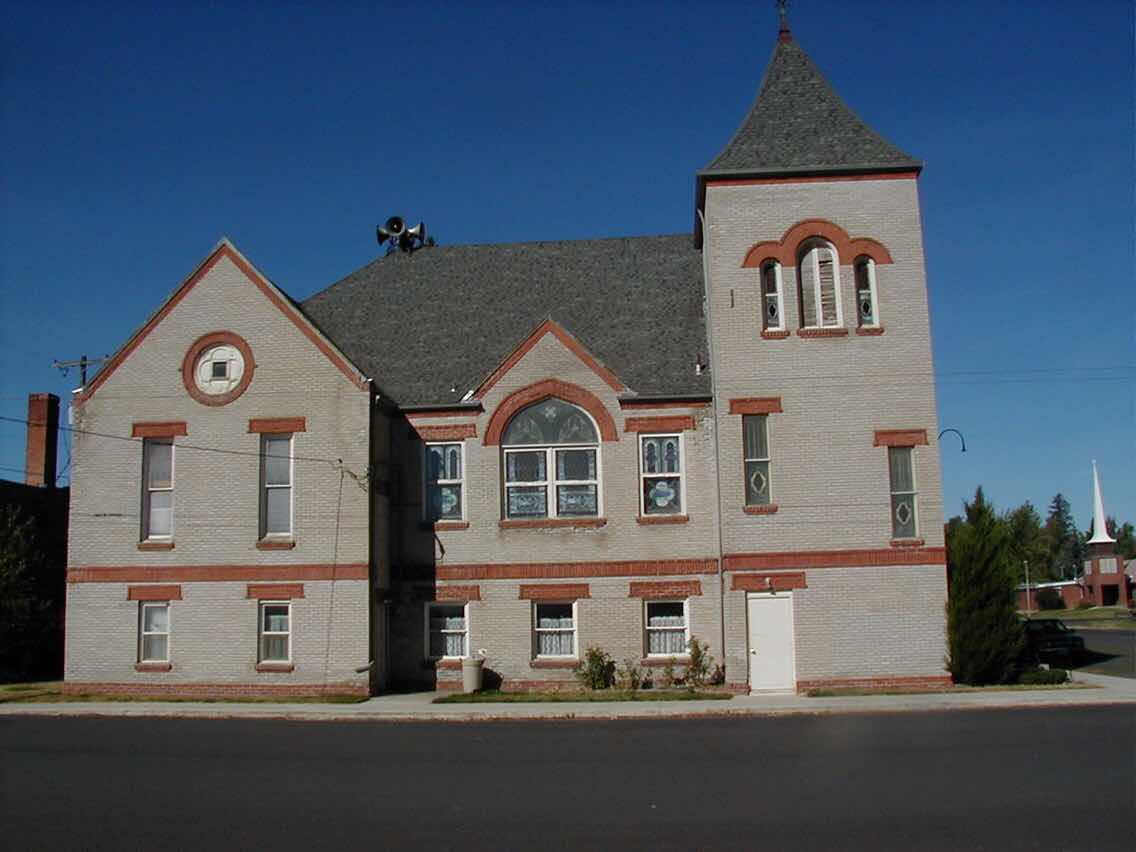
Garfield United Methodist Church closed Sunday May 28, 2018: Opened in 1881

Garfield (Whitman County), Washington


Story from 5/23/2017 Whitman County (Colfax) Gazette. Photos from 1999 of Garfield UMC provided by Jim Storms. Art work of Garfield UMC provided by Mary Ann Storms.
           
Garfield Methodist Church to close Sunday after 137 years: The last service


By Garth Meyer, Gazette Reporter, May 23, 2018

On Sunday, the Garfield Methodist Church will hold a service for the last time.

Founded in 1881 with a circuit preacher visiting private homes, the Garfield church got its first pastor six years later. The congregation bought land and the current church on Second Street was built in 1906.

Peggy Ray, its 63rd pastor, will lead the final service at 10:30 a.m. May 27.

Afterwards, the church will close with religious items removed and a de-consecration performed. The Town of Garfield has agreed to buy the building for $1 to use it as an auditorium for public events.
 

“I think it’s sad that it’s closing but I’m pleased that the building will be used, and still be an asset to the community,” said Ray.With the closing of the church, she will retire after nine years as pastor.

“I’m 79, it’s time to retire,” Ray said. “I was hopeful they would be able to continue after me. But that didn’t seem so reasonable after the last year. Basically the church is not in a position to replace me.”

The tall, brick Garfield building has a regular capacity of 100 people. Its closing is permitted by the larger United Methodist organization.

“It’s the culmination of a long process,” said Rev. Greg Sealey, supervisor for the United Methodist Church Inland District encompassing the Eastern half of Eastern Washington and part of the Idaho panhandle.

“A church generally decides for themselves, that they don’t have the money or energy to continue. Organizations, like organisms, often have a life cycle.”
The Garfield location is the only church in Sealey’s zone now closing, after two did last year, in White Bird, Idaho, and Wild Rose, an unincorporated area by Deer Park.

“A church closing doesn’t mean a church has failed. They did good work and they lived out their purpose,” Sealey said.

From 2007 to 2009, a drop in congregants in Garfield occurred after the Methodist church’s last full-time pastor left.

“We had about 30 people on Sundays when the Osveds were here,” said Mary Ann Storms, a member since 1970, referring to Pastor Joel Osved and his family. “Then it dwindled to 15 and 10 and five.”
Rev. Ray has served as a quarter-time pastor.

“I didn’t think seriously about closing until about a year ago,” she said.

In January, the church went to an every-other-Sunday format, due to its low numbers and to allow a chance for congregants to visit other churches. The Seedlings Child Care Center, started by the church and Garfield School in 2012, will continue on the church’s lower floor.

Sealey will be on site Sunday to perform the de-consecration rite. As a consecration opened the church 7,100 Sundays ago, this will mark its conclusion.

“We have a service to celebrate all the work the church has done,” Sealey said. He and local church members will also remove hymnals, religious symbols and other imagery, including the cross and flame logos of the Methodist Church, to prepare for the handover to the town.

“The conference doesn’t want the church back, they’ve got other empty churches,” said Storms.

Ray plans for the final service to include a wide selection of favorite hymns from remaining congregation and time for shared memories.

“Just like a lot of churches, the population dwindles and young people are not going to church like they used to,” said Storms, who will now drive to Colfax on Sundays. “This winter it got down to too few of us to make it viable. We’ve got younger people that don’t go to church. My kids don’t go to church.”

Garfield Methodist was known for its large choir in the early- and mid-1900s, with instrumental accompaniments. They lost their last organist/choir director at the end of 2014 when Janet Foley moved to California.

“It’s acoustically perfect,” said Ray of the building. “It’s a good size for the community.”

Garfield will now have two churches remaining in town; Garfield Christian Fellowship and Garfield Community Church.

“It’s never one thing that closes a church,” Sealey said. “There has been a shift in our larger culture. It used to be everyone went to church. Younger people, in the smaller towns, there’s not a lot of jobs for them. That’s a challenging place to have a church.”